Industrial Parks
Operational intelligence at scale: orchestrating multi-site infrastructure in extreme desert climates.
Executive Summary
Managing large-scale industrial cities and technology zones in the Middle East presents an operational challenge defined by vast geographical distances, harsh physical environments, and complex multi-vendor ecosystems.
When a leading industrial zone management authority needed to transition from fragmented sensor deployments to a unified operational model, the platform provided a single pane of glass to aggregate telemetry, eliminate integration blind spots, and protect core utility margins across extreme-temperature environments.
Operational Context & Problem Statement
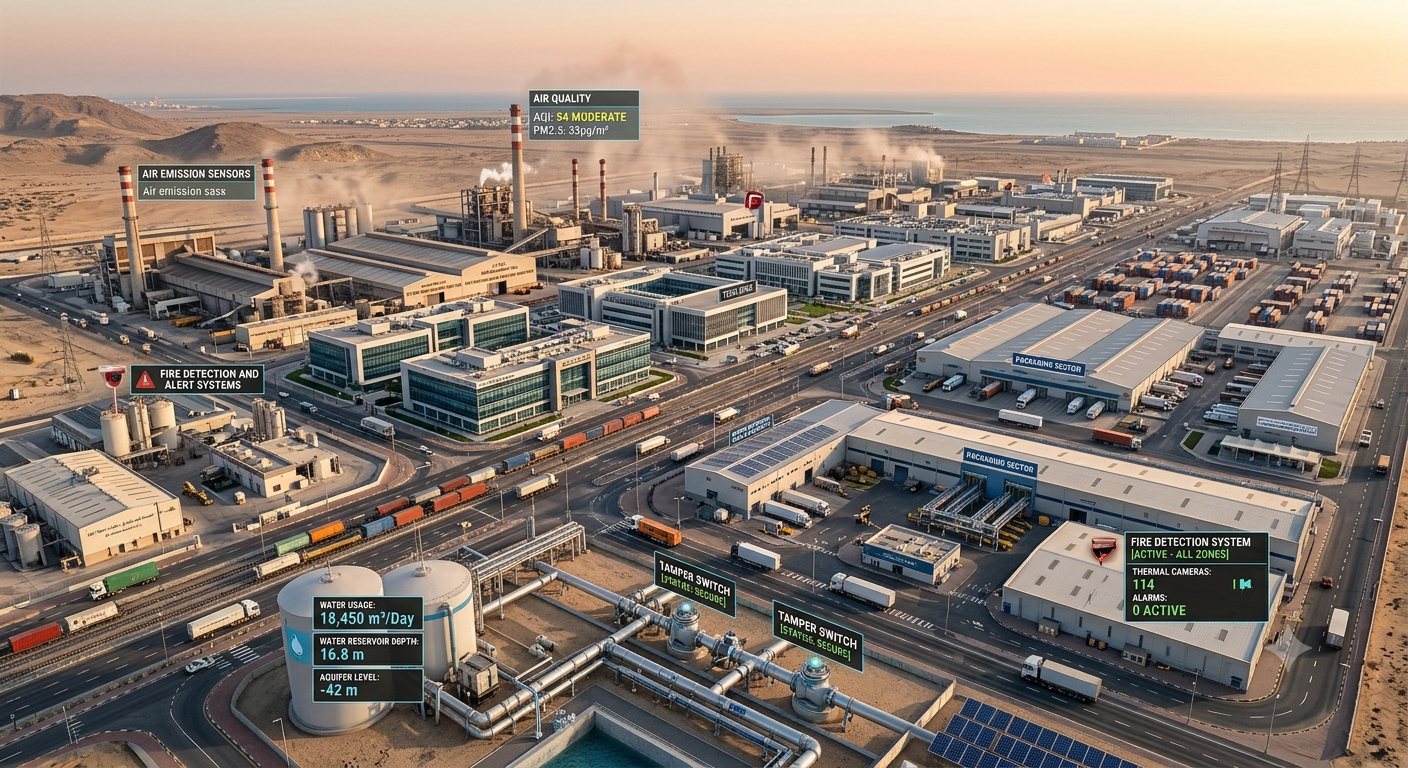
The management authority oversees extensive industrial lands encompassing water networks, environmental monitoring nodes, power distribution hubs, and physical security parameters. Operating under extreme ambient heat (exceeding 50°C), maintaining 24/7 visibility into critical physical parameters was essential:
- Utility Infrastructure: Water quality, water depth, leak detection, and tamper switches.
- Environmental Safety: Air quality indexing, ambient heat tracking, and fire detection.
- Resource Optimization: Sub-station energy consumption and load profiling.
Despite significant capital expenditure on field sensors, the agency suffered from fragmented visibility. Field telemetry traversed disparate telecom networks, leading to frequent data drops, unnotified connectivity suspensions, uncoordinated firmware over-the-air (FOTA) corruptions, and operational blind spots.
Architectural Layout: Signal to Action Pipeline
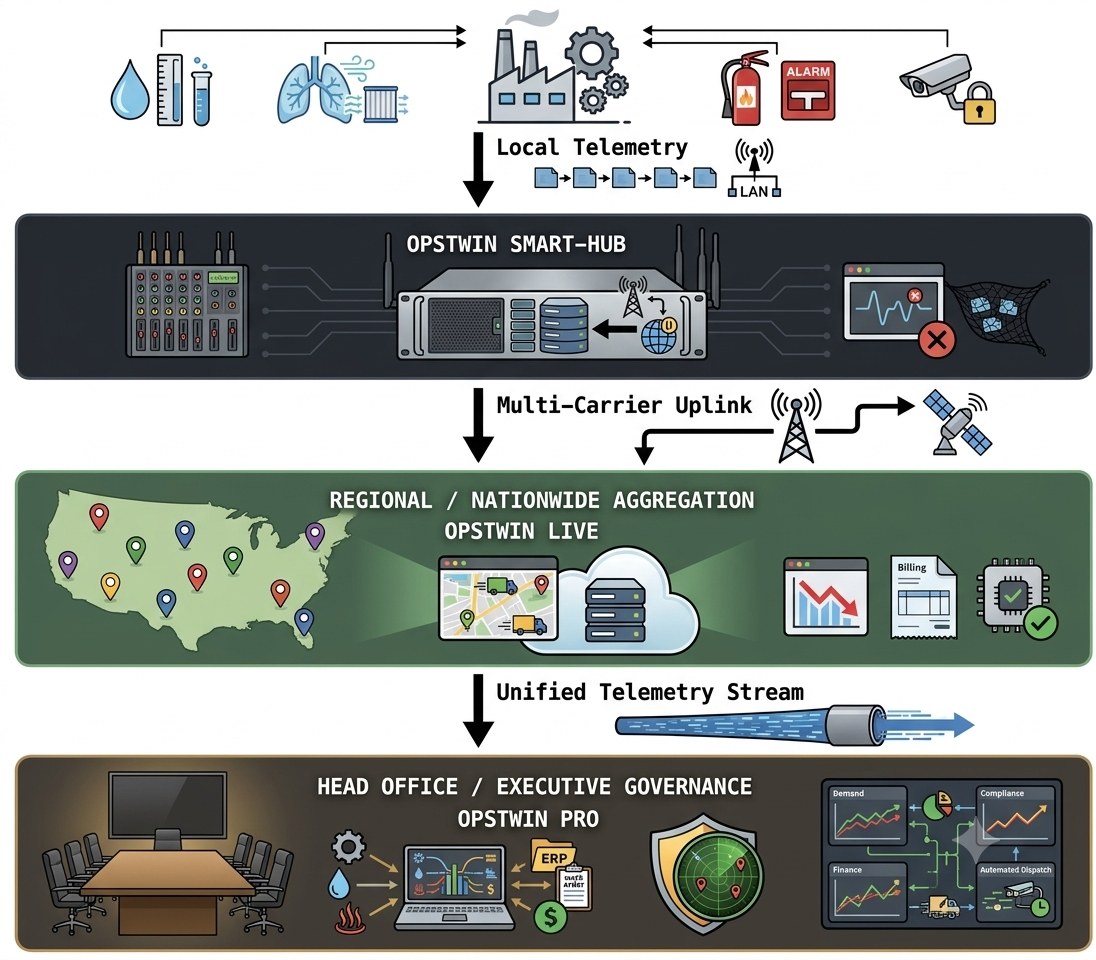
To solve vendor lock-in and multi-carrier integration drops, the deployment architecture decoupled the hardware and connectivity layers from the central orchestration engine.
Solution Deployment & Orchestration Approach
The deployment executed across three structural phases:
- Unified Asset Onboarding: Legacy equipment spreadsheets were audited and ingested into the core asset registry, mapping every physical node (water depth gauges, tamper switches, fire panels) to its digital twin contract.
- Signal Health Monitoring & Quality Scorecards: A dedicated cloud engine continuously validated payload integrity, flagging missing or malformed telemetry before it degraded downstream operational logic.
- Automated Root-Cause Diagnosis: Algorithms distinguished physical hardware failures from carrier-level data stoppages, pinpointing unpaid telecom lines, backend API failures, and silent vendor FOTA updates in real time.
1. Site-Level Deployment: Edge Monitoring via OpsTwin Smart Hub
Within individual facility zones, such as high-volume packaging plants, heavy manufacturing units, and precision engineering sectors, localized OpsTwin Smart Hubs are deployed on-site.
- Universal Edge Ingestion: The Smart Hub acts as a local gateway, directly interfacing with diverse field sensors (water depth meters, air quality sensors, fire panels, and tamper switches) regardless of protocol or manufacturer.
- Edge Resilience: Built to withstand extreme desert heat and fluctuating connectivity, the Smart Hub buffers data locally during WAN or carrier outages, ensuring zero telemetry loss.
- Signal Validation: Normalizes incoming streams in real time, catching malformed payloads, voltage drops, or uncoordinated firmware updates right at the site boundary before transmitting upstream.
2. Multi-Zone Regional Aggregation: OpsTwin Live
Across geographically dispersed industrial hubs, zones, and cities within the country, OpsTwin Live serves as the central aggregation engine.
- Geographical Consolidation: Unifies thousands of telemetry streams coming from individual Smart Hubs across disparate telecom networks (cellular, satellite, mesh) into a single map-based operational view.
- Carrier & Data Quality Diagnostics: Continuously evaluates telecom health across regions. Automatically differentiates physical hardware faults from backend carrier integration drops, expired SIM plans, or missing API handshakes.
- Zone-Wide Operations: Enables regional site managers to monitor environmental compliance, baseline utility consumption, and safety parameters across multiple zones simultaneously.
3. Strategic Business & Impact Governance: OpsTwin Pro
At the authority’s central headquarters, OpsTwin Pro unifies the physical telemetry from OpsTwin Live with digital soft signals (financial metrics, tenant SLAs, production schedules, and regulatory mandates) to safeguard facilities critical to national interest.
- Physical & Digital Signal Correlation: Maps physical sensor events against operational context, for instance correlating a sudden drop in water reservoir levels with production throughput targets or utility billing schedules.
- National Interest Impact Assessment: Provides executive leadership with a holistic impact analysis across Demand, Finance, Risk, Compliance, and Operations. If a strategic site (e.g., a defense manufacturing park or high-value export packaging hub) experiences environmental or utility degradation, OpsTwin Pro quantifies the downstream economic risk.
- Orchestrated Action: Triggers automated, cross-functional responses, ranging from dispatching field teams to re-routing resource allocations or notifying regulatory bodies, ensuring critical infrastructure maintains continuous, compliant performance.
Operational Impact & Key Learnings
The deployment proved that telemetry stability is as critical as hardware reliability:
- Pre-emptive Failure Trapping: Deteriorating signal-to-noise ratios and latency spikes served as early indicators of field sensor failure long before complete outage occurred.
- Telecom & Vendor Governance: Sudden data halts were instantly traced back to expired SIM subscriptions or uncoordinated vendor firmware pushes, allowing field teams to enforce strict Service Level Agreements (SLAs).
- Audit-Ready Financial Matching: Automated mapping of continuous energy consumption telemetry directly against supplier utility billing eliminated over-invoicing and identified leakage patterns.
| Strategic metric | Pre-deployment state | Post-deployment state |
|---|---|---|
| Site visibility | Fragmented across separate carrier dashboards | 100% centralized single-pane view |
| Data drop root-cause time | Days to weeks (manual field checks) | Instant automated carrier/API diagnosis |
| Billing verification | Periodic sample audits | 100% telemetry-to-invoice reconciliation |
| Resource efficiency | Reactive maintenance response | Predictive signal-loss dispatch |
Scalability for Large Campus Deployments
By turning raw, multi-carrier telemetry into continuous digital twin intelligence, large industrial zones and distributed edge sites can safeguard high-value assets, minimize resource waste, and maintain seamless operational continuity, even in the world’s most demanding physical environments.
Running industrial zones, utilities or distributed edge sites for your customers?