Multi-Facility Operations
Transforming distributed education infrastructure: modernizing multi-tier school campus safety and asset resilience.
Executive Summary
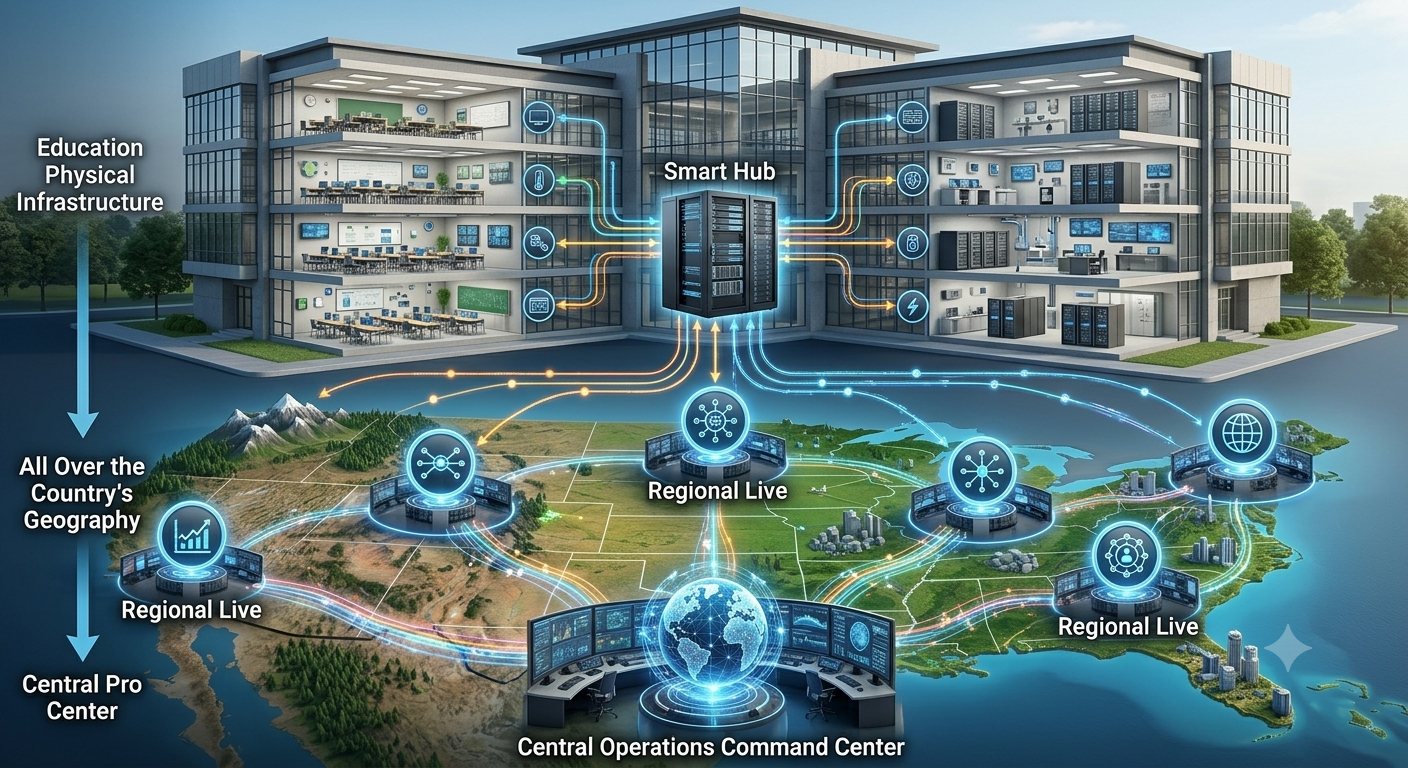
Upgrading legacy educational infrastructure across thousands of public and private school campuses presents severe operational challenges, especially across diverse geographies spanning dense urban centers and remote rural regions.
When the Education department of a country sought to modernize its national physical infrastructure, it needed a unified operational model without incurring the prohibitive costs of tearing out existing facilities. By deploying a synchronized 3-tier architecture (OpsTwin Smart-Hub, OpsTwin Live / Fleet, and OpsTwin Pro), the department successfully transformed legacy and modern school campuses into safe, energy-efficient, and SLA-governed educational environments.
Operational Context & Problem Statement
The central education authority oversees thousands of school campuses operating across varying structural ages and network environments:
- Legacy Physical Infrastructure: Older school buildings lacked structured cabling, smart metering, and automated building management systems, resulting in unmonitored power consumption and delayed maintenance responses.
- Safety & Security Risks: School principals and municipal authorities lacked real-time visibility into unauthorized site entry, perimeter breaches, or on-campus safety incidents (e.g., slips, falls, or fights).
- Vendor & Service SLA Friction: Facility maintenance and repair services were fragmented across multiple regional contractors without a centralized mechanism to track ticket resolution times or service quality.
- Network Intermittency & Privacy Concerns: Remote school sites suffered from unreliable telecom links, while strict national privacy regulations prohibited streaming raw video footage outside school grounds.
Architectural Layout: Edge-to-Executive 3-Tier Pipeline
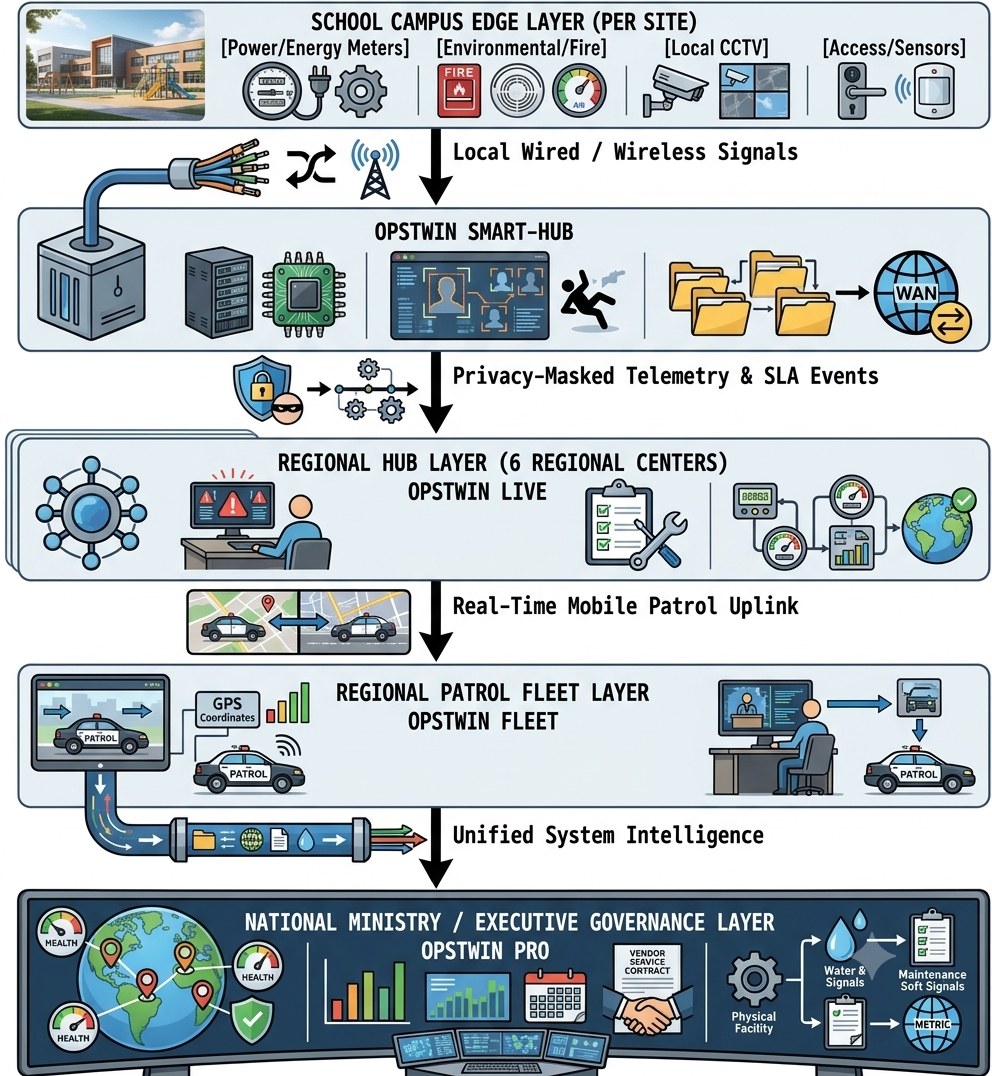
The architecture decouples localized edge monitoring from central management. Edge intelligence processes high-bandwidth telemetry locally, propagating only privacy-masked metadata, critical alerts, and aggregated health metrics to regional and national command centers.
Solution Deployment & Orchestration Approach
1. Hybrid Campus Onboarding & Edge Resilience (OpsTwin Smart-Hub)
To avoid operational disruption, each school campus was fitted with an OpsTwin Smart-Hub tailored to its physical layout:
- Adaptive Connectivity: Modern campuses utilized existing wired Ethernet cabling, while legacy schools integrated low-power wireless sensor networks.
- Edge Intelligence & Local Privacy: Raw surveillance streams remain strictly within the school premises. The Smart-Hub processes video locally to detect incidents (e.g., slips, falls, or altercations), notifying designated school staff instantly while transmitting only anonymized, masked metadata to external systems.
- Offline Operations: In remote regions with intermittent network connectivity, the Smart-Hub buffers operational data locally, seamlessly synchronizing with regional systems once WAN links are restored.
2. Regional Intervention & Mobile Fleet Dispatch (OpsTwin Live & OpsTwin Fleet)
Operations were grouped under 6 Regional Command Centers running OpsTwin Live and OpsTwin Fleet:
- Regional Incident Management: Regional teams monitor critical infrastructure breakdowns, energy anomalies, and security events across their assigned school clusters.
- Mobile Patrol Governance: Via OpsTwin Fleet, central controllers track roaming physical security personnel and mobile maintenance units in real time, ensuring rapid, SLA-compliant dispatch to unauthorized entry alerts or hardware failures.
3. Central Command & SLA Analytics (OpsTwin Pro)
At the central department head office, OpsTwin Pro fuses physical telemetry with digital enterprise data (work orders, vendor contracts, school schedules, and budget allocations):
- Single Pane of Glass: Provides the executives with a bird’s-eye view of national school safety, structural asset health, and sustainability metrics.
- Vendor Performance Accounting: Reconciles contractor repair claims against verified physical telemetry and automated ticket timestamps, eliminating billing discrepancies and holding third-party vendors accountable to strict SLAs.
Key Learnings & Operational Impact
- Resilient Store-and-Forward Edge Operations: Multi-day network outages at rural sites no longer cause data blind spots; localized Smart-Hubs maintain campus safety operations uninterrupted.
- Privacy-Compliant Surveillance: Edge-based masking allowed the central department to meet stringent child data protection laws without compromising on security and physical perimeter defense.
- Closed-Loop Patrol Governance: Coupling physical facility alerts with OpsTwin Fleet reduced security dispatch response times across regional school clusters.
| Strategic dimension | Pre-deployment state | Post-deployment state |
|---|---|---|
| Site telemetry | Unmonitored legacy energy & safety signals | 100% automated edge sensing across old & new sites |
| Campus privacy | High risk from centralized video streaming | Local processing with privacy-masked edge metadata |
| Maintenance governance | Manual, unverified multi-vendor reporting | Unified, SLA-tracked online ticketing & performance audits |
| Network reliance | System failure during WAN outages | 100% edge resilience with automatic store-and-forward sync |
Win-Win Value Proposition for National School Networks
By combining edge-level intelligence, regional fleet responsiveness, and executive-level analytical clarity, the platform transforms distributed school buildings into modern, secure, and energy-efficient educational hubs, safeguarding student well-being while optimizing national operational expenditure.
Modernizing campuses or public facilities for your customers?
See OpsTwin Smart Hub · See OpsTwin Fleet · See OpsTwin Pro · Contact us today